Ultracool Dwarf Rotation
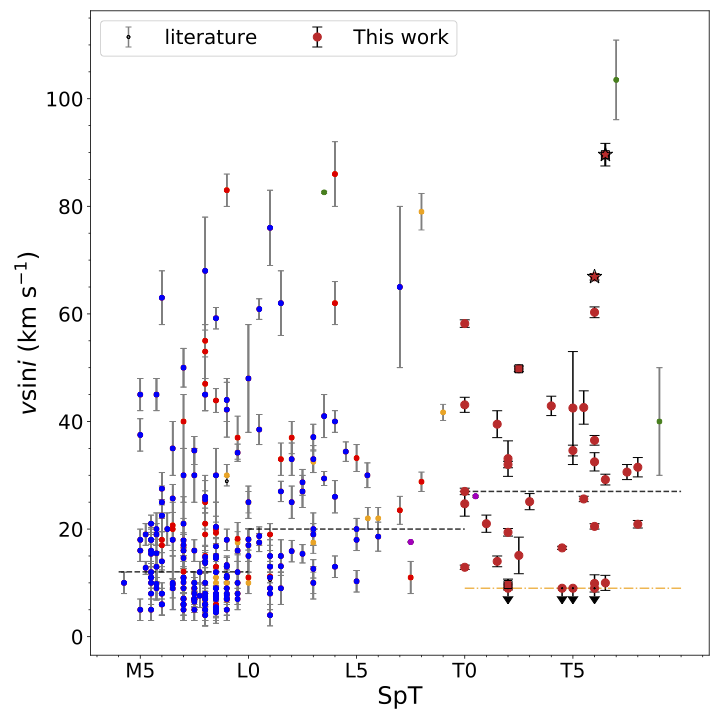
The rotation of ultracool dwarfs tells us their angular momentum evolution. Stellar and substellar objects experience different phases of angular momentum evolution, which can be constrained using their rotational period (through photometric light curves) and projected rotational velocities (vsini) through high-resolution spectroscopy.
Using the forward-modeling method, I found that the vsini trend of late-M, L, to T dwarfs goes up toward later spectral types, consistent with previous findings (but a much larger sample of T dwarfs), and showing that the angular momentum loss is less efficient for the lowest-mass regimes. The mechanism of releasing the angular momentum, thus spin-down during their field age, is less efficient for the fully convective ultracool dwarfs. You can check out my 2021 paper for more details, and SDSS/APOGEE paper.
In my 2026 landmark spin paper on giant planet and brown dwarfs, I also propose a novel specific angular momentum ratio to account for the age and mass independent spin quantity and found brown dwarfs below 40 jupiter masses retain higher angular momentum than higher mass brown dwarfs.